Creative Biolabs is offering the most comprehensive services for antibody development projects. With strict regulation and effective execution, we are dedicated to providing the most valuable solutions to complete your projects.
HighlightsCreative Biolabs is offering the most comprehensive services for antibody development projects. With strict regulation and effective execution, we are dedicated to providing the most valuable solutions to complete your projects.
HighlightsCreative Biolabs has established a broad range of platforms for developing novel antibodies or equivalents. These cutting-edge technologies enable our scientists to meet your demands from different aspects and tailor the most appropriate solution that contributes to the success of your projects.
HighlightsWith deep understanding in antibody-related realms and extensive project experience, Creative Biolabs offers a variety of references to help you learn more about our capacities and achievements, including infographic, flyer, case study, peer-reviewed publications, and all kinds of knowledge that can assist your projects. You are also welcome to contact us directly for more specific solutions.
HighlightsGet a real taste of Creative Biolabs, one of the most professional custom service providers in the world. We are committed to providing highly customized comprehensive solutions with the best quality to advance your projects.
HighlightsAt Creative Biolabs, we specialize in providing state-of-the-art Small Molecule Affinity Measurement services to accelerate your drug discovery and development pipeline. Leveraging a comprehensive suite of cutting-edge biophysical technologies, our expert scientific team delivers precise, reliable, and quantitative data on the binding interactions between small molecules and their biological targets. Understanding the affinity and kinetics of these interactions is fundamental to advancing hit validation, lead optimization, and preclinical candidate selection.
The success of any small molecule therapeutic hinges on its ability to bind to its intended biological target with high affinity and specificity. Affinity measurement, the quantification of the strength of this binding interaction, is a cornerstone of modern pharmacology and drug development. The dissociation constant (KD) is the most critical parameter derived from these studies, representing the concentration of a drug at which 50% of the target receptors are occupied. A lower K_D value signifies a higher binding affinity.
Accurate small molecule affinity measurement provides invaluable insights at every stage of the drug discovery process:
Creative Biolabs empowers researchers by providing robust and unambiguous affinity data, enabling data-driven decisions that save time, reduce costs, and de-risk drug development programs.
No single technology is optimal for every target-ligand pair. Recognizing this, Creative Biolabs has established a multi-platform approach, allowing us to select the most appropriate method based on your specific project goals, the nature of your target protein, and the properties of your small molecules.
SPR is a premier technology for real-time, label-free analysis of biomolecular interactions. It measures changes in the refractive index at the surface of a sensor chip as the small molecule analyte flows over an immobilized target protein. This allows for the precise determination of not only the equilibrium dissociation constant (K_D) but also the kinetic rate constants for association (k_a) and dissociation (k_d).
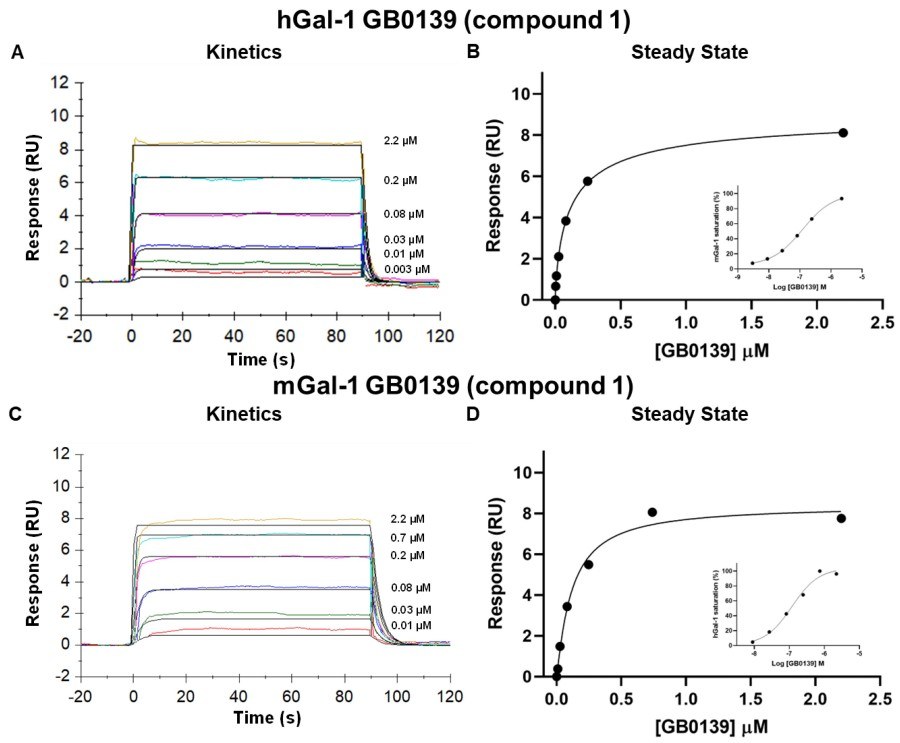 Fig. 1 GB0139 sensorgrams demonstrating human (A) and mouse (C) galectin-1 binding kinetics in SPR.1
BLI is another powerful optical, label-free technology that measures changes in the interference pattern of white light reflected from the surface of a biosensor tip. Its dip-and-read format makes it exceptionally high-throughput and tolerant of various sample types, including unpurified lysates.
Considered the gold standard for thermodynamic characterization, ITC directly measures the heat released or absorbed during a binding event. It is a true in-solution technique that requires no labeling or immobilization, providing the most accurate determination of binding affinity.
MST is a cutting-edge technology that measures the motion of molecules along a microscopic temperature gradient. A change in the hydration shell, charge, or size of a molecule upon binding to a ligand results in a change in its thermophoretic movement, which is used to quantify affinity.
Our services are tailored to support a wide array of research and development applications. We partner with you to design a study that directly addresses your scientific questions.
| Application Area | Description | Recommended Technologies |
| Fragment-Based Drug Discovery (FBDD) | Screening libraries of low-molecular-weight fragments to identify starting points for drug design. Requires high sensitivity. | SPR, MST |
| Hit-to-Lead Optimization | Quantitatively assessing SAR to guide medicinal chemistry efforts in improving compound potency and selectivity. | SPR, BLI, ITC |
| Target Validation | Confirming that a newly identified protein target physically interacts with a known active compound or tool compound. | All platforms |
| Mechanism of Action (MoA) | Differentiating between competitive, non-competitive, and allosteric binding mechanisms through carefully designed assays. | SPR, ITC |
| Off-Target & Selectivity Profiling | Measuring the binding affinity of a lead compound against a panel of anti-targets to predict potential toxicity. | BLI, SPR |
| Biophysical Characterization | Providing fundamental data on binding thermodynamics and kinetics for publications or regulatory submissions. | ITC, SPR |
Choosing Creative Biolabs for your small molecule affinity measurement needs provides a distinct competitive advantage.
To further support your research, Creative Biolabs offers a suite of Affinity Measurement related services:
Ready to precisely quantify your small molecule interactions? Contact us today to discuss your project with one of our affinity measurement specialists and receive a complimentary proposal.
Q: Which technology is the best for my small molecule project?
A: The best technology depends on several factors, including your research goal (e.g., screening vs. deep characterization), the properties of your target protein, and the availability of materials. Our experts will hold a detailed consultation with you to recommend the most suitable approach. For instance, SPR is ideal for detailed kinetics, while BLI is excellent for high-throughput screening.
Q: What is the difference between affinity (KD) and potency (IC50/EC50)?
A: Affinity (KD) is a measure of the direct binding strength between a compound and its target, a thermodynamic property. Potency (IC50/EC50) is a measure of the compound's functional effect in a biological or cellular assay. While they are often correlated, they are not the same. Strong affinity is usually a prerequisite for high potency. Our services directly measure affinity.
Q: How much sample material do I need to provide?
A: Sample requirements vary significantly by technology. MST is known for its extremely low consumption (µg of protein), while ITC may require more material (mg of protein). We provide detailed guidelines on sample amount, concentration, and purity requirements before initiating a project.
Q: Can you measure the affinity of small molecules binding to membrane proteins?
A: Yes, this is a key area of expertise for Creative Biolabs. We have specialized protocols and platforms (like MST and specific SPR techniques) optimized for challenging membrane protein targets, which can be prepared in formats like nanodiscs, liposomes, or detergent micelles.
All listed services and products are For Research Use Only. Do Not use in any diagnostic or therapeutic applications.